
There’s something about a power outage that changes the way you think.
When the lights go out, it’s not just the darkness that settles in—it’s the realization of how much we depend on systems we rarely think about. Heat, communication, food, and especially transportation all begin to feel uncertain.
During the winter storm we experienced in 2026, I saw firsthand how quickly normal life can be disrupted. Roads became difficult to navigate, fuel wasn’t something you could take for granted, and even short trips required careful thought. What used to be simple—getting to a store, checking on family, helping a neighbor—suddenly wasn’t.
It forced me to ask a question I hadn’t really considered before:
What would I do if gas wasn’t an option at all?
Scripture reminds us in Proverbs 22:3 that “the prudent see danger and take refuge, but the simple keep going and pay the penalty.” Preparedness isn’t about fear—it’s about wisdom. It’s about stewardship. It’s about being ready to care for your family and, when the opportunity arises, to help others.
In this post, I want to walk through something that often gets overlooked in preparedness planning—how we move when traditional transportation fails—and explore practical, real-world solutions that can make a difference when it matters most.
Affiliate Disclosure:
Prepared and Redeemed is supported through affiliate partnerships with trusted brands. This means that if you choose to make a purchase through links on this site, I may earn a small commission at no additional cost to you. I only recommend products I believe are practical, reliable, and aligned with a preparedness mindset focused on wisdom—not fear.
Why Transportation Fails First in a Crisis
When most people think about preparedness, they tend to focus on food, water, and maybe backup power. Those are all important—but there’s another piece that often gets overlooked until it’s too late:
the ability to move.
During the storm I wrote about in Peace in the Storm: How Faith, Preparation, and Community Carried Us Through the Winter Storm of 2026, it became clear very quickly that transportation isn’t just about convenience—it’s about access.
Access to:
- Supplies
- Family
- Help
- Safety
And when conditions change, that access can disappear almost overnight.
Roads become difficult or even dangerous to travel. Snow, ice, debris, or flooding can make even short trips unpredictable. Fuel, something we rarely think twice about, suddenly becomes something you don’t want to waste—or may not be able to replace at all.
Even if you have a working vehicle, that doesn’t always mean you have reliable mobility.
That’s because transportation depends on more than just what’s in your driveway. It depends on infrastructure—fuel availability, road conditions, and systems that are all vulnerable in a crisis.
And when those systems start to break down, movement becomes limited.
That’s where preparedness begins to shift.
It’s no longer just about what you have stored—it’s about whether you can:
- Reach someone who needs help
- Get to supplies if you run low
- Move safely when conditions aren’t ideal
In moments like that, the question isn’t:
“What do I have?”
It becomes:
“Can I get where I need to go?”
What Actually Works When Gas Isn’t Available
Once you start thinking about transportation without fuel, the goal isn’t to replace your vehicle—it’s to rethink how you move in a way that doesn’t depend entirely on fragile systems.
In most real-world situations, you’re not trying to travel long distances. You’re trying to:
- Check on family
- Pick up supplies
- Help a neighbor
- Get from one safe location to another
That kind of movement doesn’t require speed or convenience—it requires reliability.
And reliability in a crisis usually comes down to two things:
simplicity and independence.
The more something depends on outside systems—fuel stations, supply chains, perfect road conditions—the more vulnerable it becomes when those systems are disrupted.
That’s why some of the most effective solutions in a crisis are often the simplest ones.
Walking is the most basic option, but it’s not always practical—especially when distance, weather, or the need to carry supplies becomes a factor.
Traditional bicycles are another option, and they remove the need for fuel entirely. But they still require physical exertion, which can be limiting depending on terrain, health, or the situation you’re facing.
This is where modern solutions begin to bridge the gap.
Electric mobility—specifically e-bikes—offers something unique in a preparedness context. It allows you to move farther, carry more, and conserve energy, all while remaining largely independent from traditional fuel systems.
And unlike a vehicle, it doesn’t require much to keep it running.
In fact, one of the most overlooked advantages is that even a modest portable power setup can keep you moving. The same type of system used for backup power can also be used to recharge mobility when it matters most.
If you’ve already taken steps toward preparedness—whether it’s building a small supply or focusing on spiritual readiness like I talked about in Why Spiritual Prepping Matters More Than Stockpiling—this becomes a natural extension of that mindset.
It’s not about having everything.
It’s about having what works when everything else doesn’t.
E-Bikes as a Practical Preparedness Tool
When you start looking for reliable ways to move without depending on fuel, e-bikes begin to stand out as a practical middle ground.
They’re not meant to replace a vehicle in every situation—but in many real-world scenarios, they can do more than most people expect.
What makes them especially useful in preparedness is their balance between range, efficiency, and independence.
You’re not relying on gas stations.
You’re not limited to walking distance.
And you’re not exhausting yourself just to get where you need to go.
That combination matters when conditions aren’t ideal.
In a situation where roads are partially blocked, fuel is limited, or you simply need to conserve resources, having something that can move you—and a small amount of gear—can make a real difference.
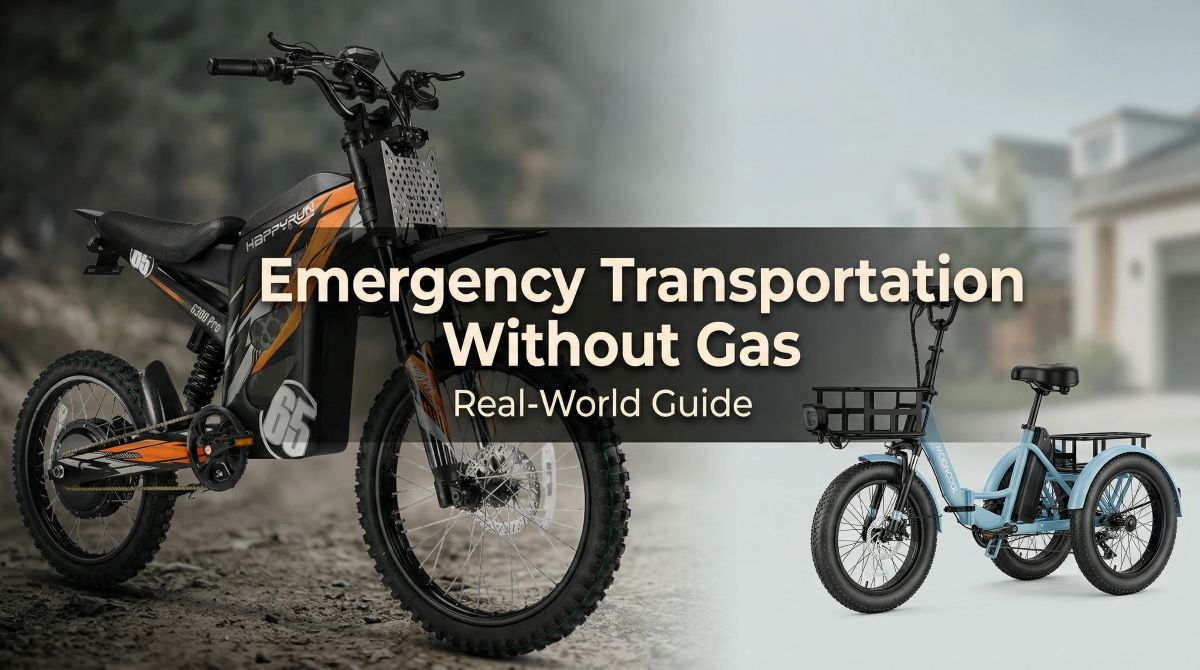
This is where I tend to lean toward something more rugged and versatile, like an e-bike from HappyRun.
The ability to handle different terrain, carry some weight, and still remain efficient gives it an advantage over more limited options. Whether it’s navigating side roads, dealing with uneven ground, or just getting around when driving isn’t practical, that flexibility matters.
It’s not about speed or convenience at that point—it’s about capability.
That said, like anything else, it’s important to be realistic.
E-bikes still have limitations:
- Range depends on battery capacity
- Terrain and weather affect performance
- Charging requires some level of planning
But even with those limitations, they fill a gap that most preparedness plans overlook.
They give you a way to move when:
- Fuel isn’t available
- Roads aren’t ideal
- Energy needs to be conserved
And in many situations, that’s enough.
If you want a closer look at how this fits into a real preparedness plan, I go deeper into this in Faith on Wheels: Why E-Bikes Belong in Your Preparedness Plan, where I break down how I approach using e-bikes as part of a practical, everyday readiness strategy.
Powering Your Transportation When the Grid Is Down
One of the biggest questions that comes up when talking about electric mobility is simple:
What happens when there’s no power?
It’s a fair question—and it’s exactly why pairing mobility with a reliable power source matters.
Because an e-bike without a way to recharge is only a temporary solution.
But when you combine it with portable power, it becomes something much more practical.
During the storm we went through, having backup power wasn’t just about lights or keeping a phone charged—it was about maintaining some level of normal function when everything else felt uncertain. It gave us options.
That same principle applies here.
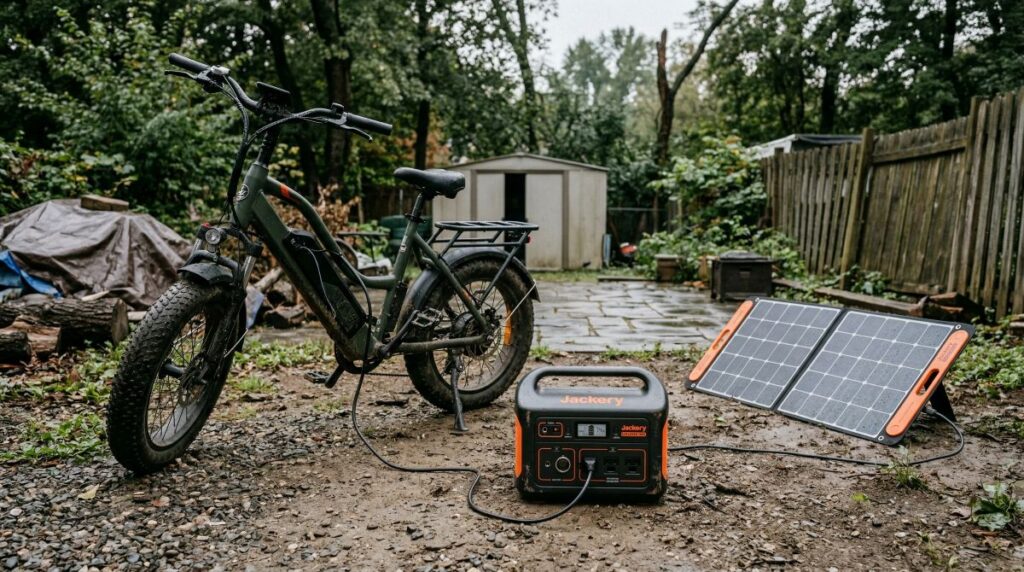
A portable power station allows you to recharge essential devices—including transportation—without relying on the grid. And it doesn’t take a massive system to make that work.
Even smaller units from brands like Jackery are capable of recharging e-bike batteries, especially when used intentionally and over time. It may not be instant, but in a preparedness scenario, steady and reliable matters more than fast.
What makes this especially valuable is the independence it creates.
Instead of relying on:
- Fuel stations
- Electrical infrastructure
- Perfect conditions
You now have a system that works together:
- Power when you need it
- Mobility when it matters
- Flexibility in uncertain situations
If you want a deeper look at how this kind of setup performs in real-world conditions, I shared my experience in my Jackery Solar Generator Review – Simply The Best, where I break down how I’ve used portable power as part of our overall preparedness plan.
Urban vs Rural Preparedness (Choosing What Fits Your Situation)
Not every preparedness plan looks the same.
Where you live plays a big role in what makes sense when normal systems are disrupted.
For those in rural or suburban areas, terrain matters. Snow, debris, side roads, and uneven ground can all change what is practical in a real-world emergency. In those situations, I tend to lean toward something more rugged and versatile, like a HappyRun e-bike, because it offers a better all-around fit for preparedness use.
At the same time, not everyone is dealing with rough terrain or longer distances.
If you live in a city or more compact environment, stability and carrying capacity may matter more than off-road capability. That is where a three-wheel option like a Mooncool electric trike can make sense, especially for hauling groceries, water, or other supplies that would be awkward to carry on a standard e-bike.
If that sounds more in line with your needs, you can take a look at the Mooncool electric trike here.
A Final Thought on Preparedness and Peace
Preparedness isn’t about having every piece of gear or anticipating every possible scenario.
It’s about being willing to think ahead, take small steps, and trust the Lord with the outcome.
Transportation is just one part of that bigger picture—but it’s an important one. When systems fail, even temporarily, the ability to move—to check on family, help a neighbor, or get what you need—can make a real difference.
What stood out to me during our storm wasn’t just what we had prepared—it was how those preparations allowed us to stay calm, make better decisions, and be available for others.
That’s the goal.
Not fear.
Not panic.
But readiness rooted in peace.
Scripture reminds us again in Proverbs 22:3 that wisdom sees what’s ahead and prepares. And when that preparation is grounded in faith, it doesn’t lead to anxiety—it leads to confidence.
If this is something you’ve been thinking about, don’t feel like you have to do everything at once.
Start simple.
Take one step:
- Strengthen your foundation
- Add what makes sense for your situation
- Focus on what helps you care for your family and those around you
And most importantly, keep your focus where it belongs.
Preparation can support you—but peace comes from the Lord.
Frequently Asked Questions
Can an e-bike really be used during a power outage?
Yes, especially when paired with a portable power source. Even smaller solar generators can recharge e-bike batteries over time, making them a practical option when traditional systems are unavailable.
How far can an e-bike go on a single charge in an emergency?
Range depends on the model, terrain, and how much assistance you use. Most e-bikes can travel anywhere from 20 to 60 miles per charge, but in a preparedness situation, conserving battery life becomes part of the strategy.
Is an e-bike better than a regular bicycle for preparedness?
Both have value, but an e-bike allows you to travel farther with less effort and carry more gear. That can make a big difference when conditions are difficult or energy needs to be conserved.
What if I live in a city—does this still apply to me?
Absolutely. Urban environments come with different challenges, and options like electric trikes can make it easier to move supplies short distances without relying on a vehicle.
About the Author

Jason Taft is the founder of Prepared and Redeemed, a faith-based preparedness website focused on helping individuals and families prepare for uncertain times with wisdom, peace, and practical steps.
Through real-life experiences—including navigating severe storms and power outages—he shares insights that combine spiritual readiness with everyday preparedness.
His goal is simple: to encourage others to stay grounded in faith while taking responsible steps to care for their families and communities.