
I. Opening Exhortation: The Question That Matters Most
“Prepare to meet your God, O Israel!” — Amos 4:12
Most people spend their lives preparing for everything except the one meeting that Scripture says is unavoidable.
We prepare for retirement.
We prepare for emergencies.
We prepare our homes, our schedules, and our futures — yet many overlook the deeper reality of preparing the soul. That’s where spiritual preparation truly begins, as explored in Why Spiritual Prepping Matters More Than Stockpiling.
But the Bible asks a far deeper and more sobering question—are we prepared to meet God?
Jesus warned that the greatest danger in the last days would not be war, famine, or even persecution, but distraction — a theme believers must understand in light of Discerning False Prophets in a Digital Age.
“Be on guard, so that your hearts are not weighed down… and that day does not catch you unexpectedly like a trap.” — Luke 21:34–35
Armageddon is not a metaphor, and it is not a storyline reserved for movies or speculation. It is a biblical reality tied to the return of Christ and the final reckoning of this age. Yet the most important issue is not when it occurs, but who you belong to when it does.
Scripture does not call believers to panic—but it does call us to watchfulness. Not fear, but faithfulness. Not speculation, but readiness.
“Be always on the watch…” — a call that resonates deeply with those learning from Lessons From the Early Church for End Times Living.
This article is not written to stir fear, set dates, or fuel endless prophecy debates. It is written to ask the question that every generation of believers has had to answer:
If Christ returned today—would your heart be ready?
Affiliate Disclosure: This article may include an affiliate link to a trusted Christian resource that supports the mission of Prepared & Redeemed. If you choose to purchase through that link, it helps support this ministry at no additional cost to you.
II. What the Bible Actually Says About Armageddon
The word Armageddon has been buried under decades of speculation, movies, and sensational headlines—but Scripture itself is remarkably clear and restrained about what it is and why it matters.
“They assembled them at the place that in Hebrew is called Armageddon.” — Revelation 16:16
Armageddon is not a vague symbol for chaos — and to understand real biblical judgment, consider how Scripture frames God’s purposes differently than modern cultural expectations, as explored in Why Isn’t America Mentioned in End Times Prophecy?.
The Bible does not present Armageddon as humanity accidentally spiraling out of control. It presents it as the moment when human pride, deception, and defiance reach their full measure—and God brings history to its appointed end.
What is often missed is who stands at the center of this event.
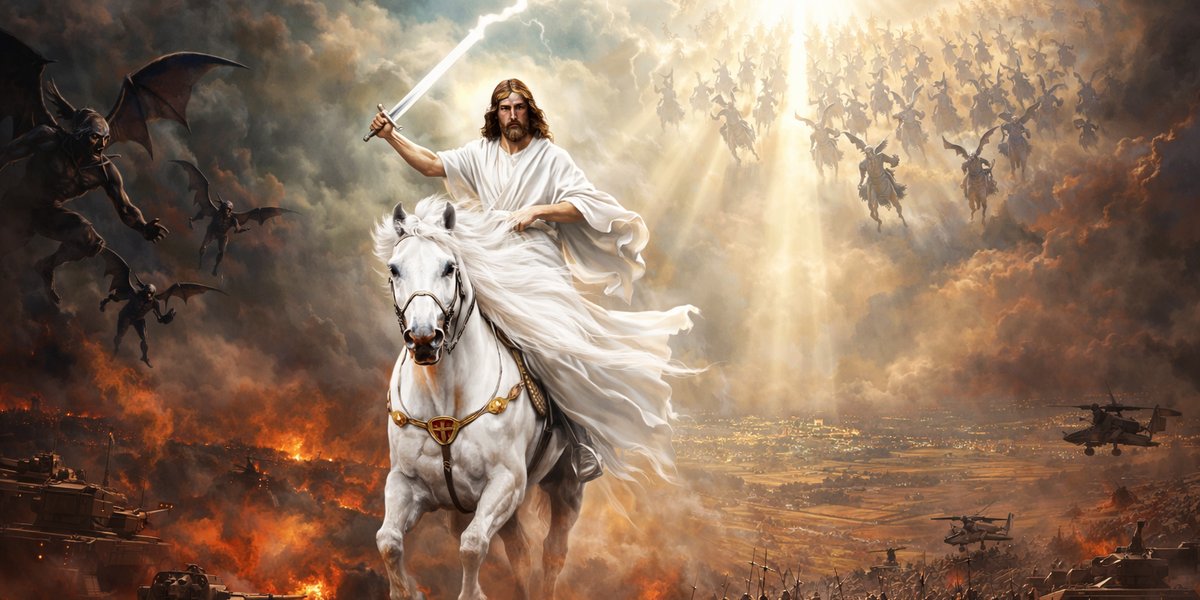
“I saw heaven opened, and behold, a white horse! The one sitting on it is called Faithful and True… and on His robe and on His thigh He has a name written, King of kings and Lord of lords.” — Revelation 19:11, 16
Jesus Christ does not return as a suffering servant in this moment. He returns as Judge, Warrior, and King. Not to negotiate. Not to plead. But to reign.
This is uncomfortable for a world that prefers a gentle, non-confrontational Jesus—one who affirms without correcting and saves without judging. But the Bible presents a complete Christ: merciful Savior and righteous Judge.
Armageddon is not about God losing patience. It is about God keeping His word.
For centuries, God has called humanity to repentance. He has sent prophets, warnings, and ultimately His own Son. Judgment does not arrive because God is cruel—but because rebellion, when left unchecked, destroys everything it touches.
And yet—even here—Scripture does not frame Armageddon as chaos winning the day.
It is not the victory of darkness.
It is the end of deception.
It is the moment when false powers fall, unjust systems collapse, and the authority of Christ is made visible to all creation. Evil is not merely restrained—it is confronted and defeated.
For believers, this matters deeply.
Because Armageddon does not ask whether the world was religious, informed, or spiritually curious. It asks one question only:
Were you aligned with the King—or resisting Him?
That is why Scripture repeatedly shifts the focus away from speculation and toward readiness. The Bible does not encourage us to obsess over timelines, but it does urge us to examine our hearts.
The reality of Armageddon is not meant to terrify those who belong to Christ. It is meant to clarify allegiance.
III. Signs of the Times: Why This Conversation Matters Now

“You will hear of wars and rumors of wars… but see that you are not alarmed.” — Matthew 24:6
Jesus never told His followers to ignore the signs of the times. But neither did He tell them to panic.
Instead, He gave clear instruction: watch, discern, and remain grounded.
The Bible teaches that turmoil, deception, and moral collapse would increase as history moves toward its appointed conclusion. These signs are not given so believers can obsess over headlines, but so they will not be caught off guard—spiritually unanchored when pressure intensifies.
“Nation will rise against nation… all these are but the beginning of the birth pains.” — Matthew 24:7–8
Birth pains increase in frequency and intensity as delivery approaches. Jesus deliberately chose this imagery—not to inspire fear, but to communicate inevitability. What we are witnessing in the world today should not shock those who know Scripture. It should steady them.
At the same time, Scripture warns that the greatest danger in the last days is not external chaos, but internal compromise.
“People will be lovers of self… lovers of pleasure rather than lovers of God.” — 2 Timothy 3:1–5
Deception does not always arrive wearing the face of persecution. Often it arrives through comfort, distraction, and distorted teaching. That is why discernment is more essential now than ever, especially in an age where voices are many and truth is often diluted. This challenge is addressed more deeply in Discerning False Prophets in a Digital Age, where believers are reminded to test every message against Scripture—not popularity or emotion.
The question is not whether the world is shaking. It is.
The question is whether our faith is rooted deeply enough to stand when it does.
Scripture also speaks of systems being shaken—economic, political, and cultural—so that what cannot be shaken may remain.
“Once more I will shake not only the earth but also the heavens.” — Hebrews 12:26–27
These shakings are not random. They expose where trust has been misplaced. Many are beginning to sense this instability, especially as conversations increase around financial control, centralized systems, and the erosion of freedoms—topics explored thoughtfully in Financial Shaking, the Cashless Society, and the Mark of the Beast. Yet even here, the Bible redirects our focus away from fear and toward faith.
This is where many believers struggle—not because they are unaware of what is happening, but because awareness has not yet matured into spiritual readiness.
That is why Scripture repeatedly calls God’s people to live differently in times of pressure, drawing strength from the example of those who walked faithfully before us. The early church faced uncertainty, persecution, and systemic hostility—yet they endured by clinging to Christ, a lesson explored further in Lessons From the Early Church for End Times Living.
The signs of the times are not a call to retreat from the world, nor to speculate endlessly about dates and events. They are a call to examine where our confidence truly rests.
Are we anchored in Christ—or merely informed about prophecy?
Because awareness alone will not carry us through what lies ahead.
IV. The End Is Not the End

“I am the resurrection and the life. Whoever believes in Me, though he die, yet shall he live.” — John 11:25
For many, the idea of the end times is overwhelming. Words like judgment, tribulation, and Armageddon are often associated only with destruction and loss. But Scripture tells a fuller story—one that does not end in despair, but in redemption.
The end of this age is not the end of God’s plan. It is the completion of it.
From Genesis to Revelation, the Bible reveals a God who restores what sin has broken. Judgment is real, but it is never arbitrary. It clears the way for renewal, justice, and the fulfillment of every promise God has made to His people.
“Then I saw a new heaven and a new earth… He will wipe away every tear from their eyes, and death shall be no more.” — Revelation 21:1, 4
For those who belong to Christ, the end times are not about annihilation—they are about transition. The shaking of this world makes room for a kingdom that cannot be shaken.
“Therefore let us be grateful for receiving a kingdom that cannot be shaken.” — Hebrews 12:28
This truth is essential, because fear distorts perspective. When fear dominates, believers are tempted to either withdraw in panic or harden their hearts toward others. Yet Scripture calls us to something better: steadfast hope anchored in Christ.
That hope is explored more deeply in Faith Over Fear in Times of Crisis, reminding us that confidence in God’s sovereignty does not ignore reality—it places reality in its proper context.
The Bible does not promise that the final days will be easy. It does promise that they will be meaningful. Every trial, every act of faithfulness, every quiet decision to obey Christ matters—especially when the world feels unstable.
And this hope does not excuse complacency.
Hope fuels holiness, not apathy. Knowing that God will make all things new is precisely why believers are called to live differently now—loving deeply, forgiving freely, and standing firm in truth. Even forgiveness, often overlooked in discussions of the end times, remains central to Christlike living, as reflected in The Power of Forgiveness During End Times Chaos.
The end is not the end for those in Christ.
It is the moment when faith becomes sight.
When endurance gives way to joy.
When the long wait gives way to eternal communion with God.
And that reality reframes everything—including how we prepare.
V. Awareness vs. Readiness: Knowing the Signs Is Not Enough
“Not everyone who says to Me, ‘Lord, Lord,’ will enter the kingdom of heaven, but the one who does the will of My Father.” — Matthew 7:21
There is a critical difference between being aware of prophecy and being ready to meet Christ.
Many people today are informed. They follow world events, recognize biblical patterns, and can speak intelligently about the signs of the times. Yet Scripture repeatedly warns that knowledge alone is not the same as obedience.
Jesus addressed this directly—not to unbelievers, but to those who thought they were prepared.
“On that day many will say to Me, ‘Lord, Lord…’ and then will I declare to them, ‘I never knew you.’” — Matthew 7:22–23
These are some of the most sobering words in the Bible. They reveal that proximity to spiritual truth does not guarantee spiritual alignment. Familiarity with religious language does not equal a surrendered heart.
Jesus reinforced this warning in the parable of the ten virgins.
“Five of them were foolish, and five were wise.” — Matthew 25:2
All ten were waiting.
All ten expected the bridegroom.
All ten believed the event was coming.
The difference was not belief—it was preparation.
The foolish virgins were not rebellious or openly hostile. They were simply unready. They assumed they had more time. They assumed intention would substitute for action.
And that assumption proved fatal.
This is where many believers struggle today. We live in an age of constant spiritual exposure—sermons, podcasts, articles, and prophecy discussions are everywhere. But exposure can quietly replace examination.
Scripture calls us to test ourselves, not merely inform ourselves.
“Examine yourselves, to see whether you are in the faith.” — 2 Corinthians 13:5
Readiness is not about perfection. It is about relationship. About walking daily with Christ, repenting when convicted, forgiving when wronged, and obeying even when obedience is costly.
This is why spiritual preparation must always come before practical preparation. Supplies may sustain the body for a season, but only a transformed heart can endure what lies ahead—a truth explored more fully in Why Spiritual Prepping Matters More Than Stockpiling.
Awareness can impress others.
Readiness sustains the soul.
And readiness is not built in moments of crisis—it is cultivated quietly, faithfully, day by day.
That is the difference Scripture presses us to understand. Because when pressure comes—and it will—only what has been rooted deeply will remain standing.
VI. What It Means to Be Spiritually Prepared
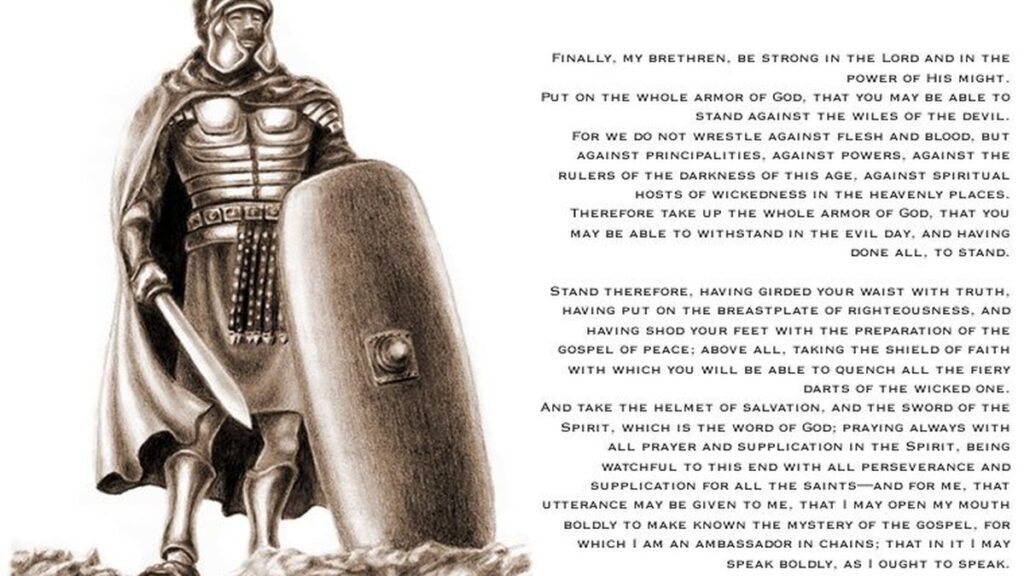
“Put on the whole armor of God, that you may be able to stand against the schemes of the devil.” — Ephesians 6:11
Spiritual preparedness is not about having all the answers. It is about having a steady walk with Christ—one that endures when comfort fades and pressure increases.
The Bible never describes readiness as passive belief. It describes it as an active posture of the heart.
To be spiritually prepared means living in ongoing repentance, not because we fear condemnation, but because we desire closeness with God.
“If we confess our sins, He is faithful and just to forgive us.” — 1 John 1:9
Prepared believers are not sinless—but they are teachable, quick to repent, and unwilling to justify compromise. They do not delay obedience while waiting for more convenient seasons.
Spiritual readiness also means abiding in Christ daily.
“Abide in Me, and I in you… apart from Me you can do nothing.” — John 15:4–5
This abiding is not occasional. It is cultivated through prayer, Scripture, humility, and submission. It is choosing Christ when distractions compete for attention and when following Him costs more than it comforts.
Jesus was clear:
“If anyone would come after Me, let him deny himself and take up his cross daily and follow Me.” — Luke 9:23
Preparedness is not built in moments of panic—it is forged in daily faithfulness.
It means learning to trust God when circumstances are uncertain. It means standing firm when truth is unpopular. It means loving others—even enemies—without surrendering conviction.
This kind of readiness strengthens believers to endure hardship without losing hope, a theme explored further in Persecution and Endurance: How to Stand Firm, which reminds us that endurance has always been part of the Christian calling.
Spiritual preparedness also includes guarding the heart.
“Above all else, guard your heart, for everything you do flows from it.” — Proverbs 4:23
What we allow to shape our thinking, influence our values, and occupy our time will determine how we respond when pressure comes. Prepared believers are intentional about what they consume—spiritually, mentally, and emotionally—because they know compromise rarely arrives suddenly. It creeps in quietly.
Ultimately, being spiritually prepared means placing complete trust in Christ—not in systems, savings, strength, or strategy.
Those things may fail.
Christ will not.
And it is that trust that steadies the soul for whatever lies ahead.
VII. A Word to the Fearful, the Doubting, and the Weary
“Let not your hearts be troubled. Believe in God; believe also in Me.” — John 14:1
Not every believer reads about the end times with confidence. Many read with heavy hearts.
Some are tired.
Some are overwhelmed.
Some carry quiet fears they rarely voice—about their faith, their family, or their ability to endure what may come.
Scripture does not ignore these realities. In fact, Jesus spoke words of comfort to His disciples knowing that dark days were ahead.
“In the world you will have tribulation. But take heart; I have overcome the world.” — John 16:33
Christ never promised ease. He promised presence.
For the fearful, the Bible does not offer denial—it offers reassurance. God remains sovereign even when the world feels unstable. Nothing unfolds outside His knowledge or control.
“Fear not, for I am with you… I will uphold you with My righteous right hand.” — Isaiah 41:10
For those who doubt—who wonder if their faith is strong enough or their walk consistent enough—Scripture reminds us that salvation rests not on our grip on Christ, but on His grip on us.
“There is therefore now no condemnation for those who are in Christ Jesus.” — Romans 8:1
Doubt does not disqualify you. Silence before God does not mean abandonment. Even weariness does not signal failure—it often signals that you have been standing longer than you realize.
This is why Scripture repeatedly calls believers to replace fear with trust, not through denial, but through surrender—a theme explored more fully in Faith Over Fear in Times of Crisis. Fear fades not when circumstances improve, but when confidence in God deepens.
And to the weary—those who feel spiritually exhausted—God speaks tenderly.
“Come to Me, all who labor and are heavy laden, and I will give you rest.” — Matthew 11:28
Rest does not mean retreating from faith. It means leaning more fully into Christ, allowing Him to carry what was never meant to rest solely on your shoulders.
The end times are not a test of spiritual toughness. They are a call to enduring trust.
Christ does not ask His people to stand alone.
He does not demand perfection.
He does not abandon those who stumble.
He promises to walk with them—step by step—until faith becomes sight.
And that promise brings us to the most important question of all.
VIII. A Call to Decision (Invitation, Not Pressure)

“Choose this day whom you will serve.” — Joshua 24:15
Every discussion about the end times eventually arrives at the same place—not timelines, not speculation, not preparedness plans—but the heart.
Scripture makes it clear that neutrality is not a safe position. To delay a decision is, in itself, a decision.
“Now is the favorable time; behold, now is the day of salvation.” — 2 Corinthians 6:2
Spiritual readiness does not begin with knowledge. It begins with relationship.
You can be aware of prophecy and still be unprepared.
You can recognize the signs and still be standing at a distance from Christ.
You can admire Jesus—and never truly follow Him.
This is why Scripture continually calls people not just to believe about Christ, but to belong to Him.
If you have never placed your trust in Jesus—if you have never surrendered your life, your sin, and your future to Him—this invitation is for you. Salvation is not earned by good behavior or religious effort. It is received through repentance and faith.
“If you confess with your mouth that Jesus is Lord and believe in your heart that God raised Him from the dead, you will be saved.” — Romans 10:9
And if you are already a believer, this call still matters. Scripture repeatedly urges followers of Christ to examine their walk, renew their commitment, and return to their first love.
The end times do not call for panic—they call for clarity.
They do not demand perfection—they invite surrender.
If you’re seeking clarity about what it truly means to follow Jesus, you may find it helpful to read How to Know Jesus, which walks through the foundations of faith with simplicity and Scripture.
The question is not whether the world is changing.
It is.
The question is whether your life is anchored in the One who does not.
Christ stands ready—not with condemnation, but with open arms. He calls people out of darkness, confusion, fear, and delay into forgiveness, peace, and eternal life.
And that call is not reserved for a future moment.
It is extended now.
Father God,
I come to You knowing that I am a sinner in need of Your grace.
I confess that I have fallen short and that I cannot save myself.
I believe that Jesus Christ is Your Son,
that He died on the cross for my sins,
and that You raised Him from the dead.
I turn away from my old life and place my trust in Jesus alone.
I surrender my heart, my future, and my will to You.
Please forgive me, cleanse me, and make me new.
Fill me with Your Holy Spirit and help me follow You faithfully
all the days of my life.
Jesus, I confess You as Lord.
Thank You for saving me.
In Jesus’ Name
Amen.
Final Reflection & Community Invitation
How are you preparing spiritually in these times?
I invite you to share your thoughts, reflections, or questions in the comments below. This is a community built on faith, truth, and encouragement—not fear.
If this message stirred your heart, consider sharing it with someone you love. Eternal matters are too important to keep to ourselves.
Prepared & Redeemed exists for one purpose:
to encourage spiritual readiness first—because everything else flows from that foundation.
About the Author
 My name is Jason Taft—and I’m a sinner saved by grace.
I didn’t grow up walking with God. I grew up in a divided home, watching addiction and brokenness shape my early years. Although my mom came to faith when I was young, I ran the opposite direction. What started as rebellion turned into years marked by sex, drugs, alcohol, and the rock-and-roll lifestyle—all driven by a deep need to escape pain and fill a void I didn’t yet understand.
By my late teens, I was living hard and fast, outwardly functioning but inwardly falling apart. Addiction, broken relationships, and spiritual emptiness followed me for years. Even when I tried to clean up my life, shame and condemnation whispered that God could never truly love someone like me.
But God never let go.
Through conviction, patience, and mercy, Jesus met me where I was—not after I fixed myself, but while I was still broken. Over time, He replaced addiction with dependence on Him, chaos with clarity, and fear with faith. I’m not perfect. I still stumble. But I belong to Christ.
Prepared & Redeemed was born out of that transformation. This site exists to point people to spiritual readiness first—because no amount of preparation for this world matters if we aren’t prepared for eternity.
If God can save me, He can save anyone. And if Jesus is calling you today, don’t ignore Him. He’s still in the business of redeeming lives.
— Jason Taft
This is a deeply structured and thoughtfully communicated piece. From a communication perspective, what works especially well is the intentional pacing you guide the reader from reflection to clarity without resorting to fear-based language. The consistent use of Scripture, clear sectioning, and repeated refocusing on readiness over speculation keeps the message grounded and accessible, even given the weight of the topic. I also appreciate how the tone balances conviction with compassion, inviting self-examination rather than defensiveness. This is a strong example of how complex, emotionally charged ideas can be conveyed with clarity, purpose, and respect for the reader’s journey.
Kavitha, thank you for such a thoughtful and perceptive response. I genuinely appreciate you taking the time to engage with the how as much as the what of the message.
Your observation about pacing is especially meaningful to me. With a topic as weighty as this, my prayer was to guide readers toward clarity and readiness without leaning on fear or speculation. Scripture gives us firm ground, and I wanted that foundation to lead the conversation — not headlines, timelines, or emotional pressure.
I’m also grateful you noticed the balance between conviction and compassion. Spiritual readiness, at its core, is an invitation — a call to examine our hearts in light of truth, not to defend ourselves or be overwhelmed. If the piece encouraged reflection rather than anxiety, then it accomplished what I hoped it would.
Thank you again for your kind words and for articulating the intent behind the structure so clearly. Comments like yours help affirm that faithful, respectful communication still resonates — even when addressing challenging truths.
Thank you for sharing this powerful and Scripture-centered message, Jason. I really appreciate how you consistently bring the focus back to readiness of the heart rather than speculation about timelines. The contrast you made between awareness and readiness stood out to me—especially the reminder that knowledge alone doesn’t equal obedience or relationship with Christ.
Your testimony adds depth and credibility to the message, and I think many readers will find hope in seeing how God redeems broken lives rather than waiting for perfection. This was a sobering but encouraging read, grounded in truth and hope instead of fear. Thank you for pointing us back to daily faithfulness and trust in Christ above all else.
Hi Monica,
Thank you so much for this thoughtful and encouraging comment. It truly means a lot to me, especially coming from someone who clearly understands the difference between knowing Scripture and living it out. You captured the heart of the message perfectly — awareness without readiness can easily become distraction, but readiness is always rooted in relationship with Christ.
I’m also grateful you mentioned the testimony aspect. If God can redeem broken lives like mine, then there’s real hope for anyone who feels unqualified or “not ready yet.” That’s exactly why I wanted to keep the focus on daily faithfulness, repentance, and trust, rather than fear or speculation.
Thank you again for taking the time to share this. Comments like yours encourage me to keep pointing people back to Christ, where true preparation really begins.
Hello Jason!
This article really got me thinking — it struck a chord in a way that’s both sobering and encouraging. I’ve often wondered how to balance living in the moment with being spiritually prepared, and your points about self-reflection, prayer, and grounding our faith felt like practical steps rather than fear-based messages. It reminded me that being prepared isn’t about anxiety or perfection, but about growing in faith and staying connected to what truly matters.
I’d love to hear more about how you personally stay spiritually grounded when the world feels chaotic. Are there daily practices or rhythms you’ve found especially helpful for keeping your heart steady? And when worries or doubts creep in, what helps you bring your focus back to peace and trust? This gave me a lot to reflect on — thank you for a thoughtful and meaningful read.
Angela M 🙂
Hi Angela, thank you for such a thoughtful and heartfelt comment. I’m really grateful you shared this, because it touches the very reason I felt led to write that piece.
For me, staying spiritually grounded in a chaotic world isn’t about doing everything perfectly, it’s about daily return. I try to begin each day by intentionally slowing down, even if it’s just a few quiet minutes in prayer and Scripture before the noise starts. That small act of surrender helps re-center my heart and reminds me that I’m not carrying the weight of the world on my own shoulders.
When worries or doubts creep in (and they do), I’ve learned to pause and bring them honestly before God instead of trying to push them away. Scripture, especially the Psalms, has a way of re-anchoring my perspective; not by denying the reality of fear, but by pointing me back to trust. I also find that gratitude, even for small things, softens anxiety and restores peace.
Above all, I remind myself that spiritual preparedness isn’t rooted in fear of what’s coming, but in confidence in Who is already sovereign over it all. That truth steadies my heart when headlines shake it.
Thank you again, Angela, for engaging so deeply and openly. Your reflections add real depth to this conversation, and I’m thankful you’re here walking this journey alongside me.